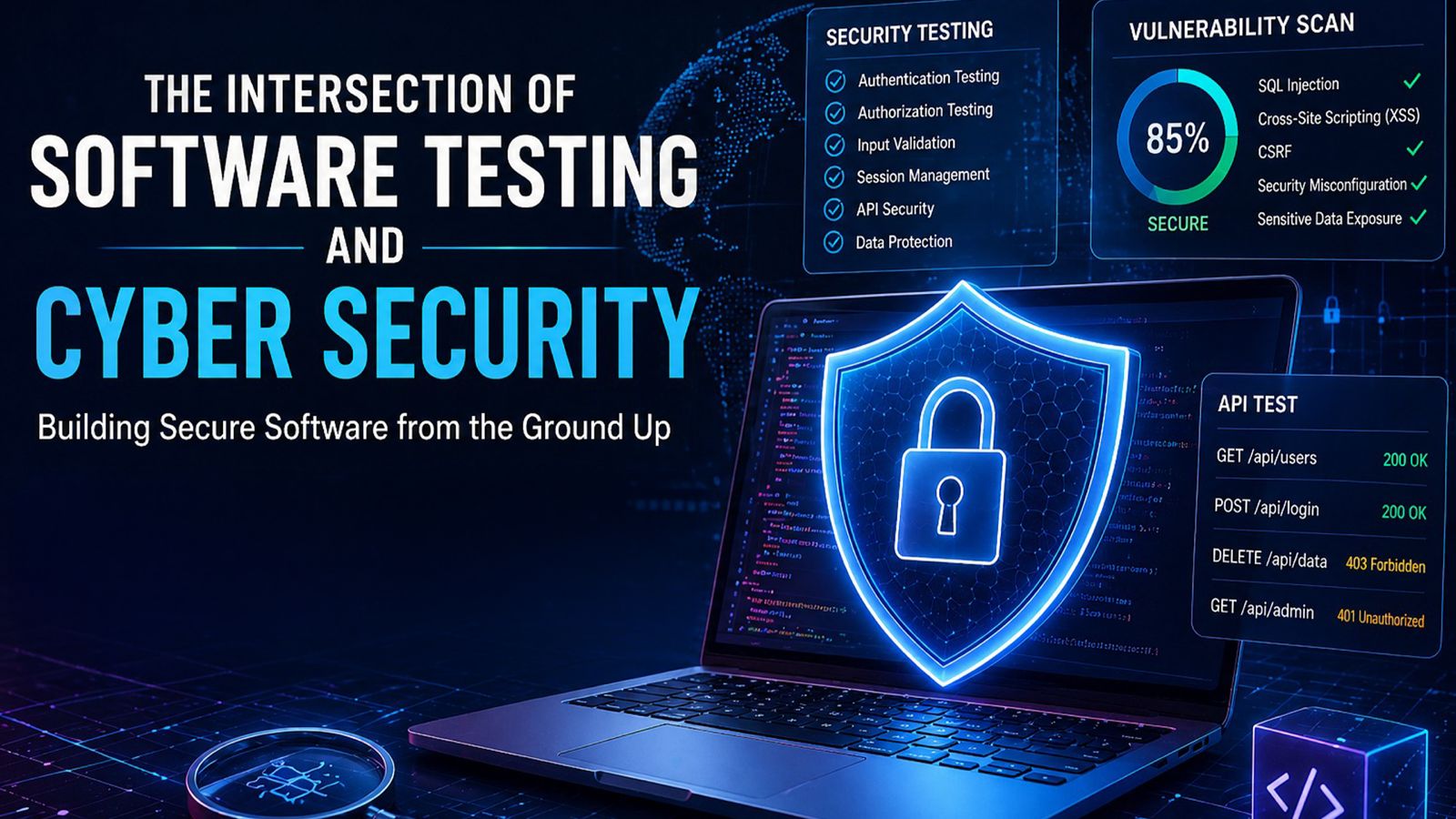

In today’s digital world, building software that simply “works” is no longer enough. Applications must also be secure, resilient, and trustworthy. This is where the powerful intersection of software testing and cybersecurity comes into play—two disciplines that, when combined, create robust and reliable systems capable of withstanding both user demands and malicious attacks.
Beyond Functionality: The Evolution of Testing
Traditionally, software testing focused on ensuring that an application behaves as expected. Quality Assurance (QA) engineers verify functionality, performance, and usability through various testing methods such as unit testing, integration testing, and regression testing.
However, as applications have become more interconnected and data-driven, the scope of testing has expanded. It’s no longer sufficient to ask:
- Does the application work?
- Is it user-friendly?
- Is it fast?
Today, we must also ask:
- Is the application secure?
- Can it be exploited?
- Are user data and system integrity protected?
This shift has given rise to a crucial domain: Security Testing.
Cybersecurity: Thinking Like an Attacker
While software testers ensure that systems function correctly, cybersecurity professionals approach systems from a different perspective—they attempt to break them.
Cybersecurity focuses on identifying vulnerabilities, preventing unauthorized access, and protecting sensitive data. Techniques such as penetration testing, vulnerability scanning, and security audits are used to uncover weaknesses before malicious actors can exploit them.
In essence:
- A tester validates expected behavior
- A security expert challenges the system with unexpected and hostile scenarios
Security Testing: Where QA Meets Cyber Defense
Security testing acts as a bridge between software testing and cybersecurity. It integrates security principles directly into the testing lifecycle, ensuring that vulnerabilities are detected early in development rather than after deployment.
Key areas of security testing include:
- Authentication and Authorization Testing
Ensuring users can only access what they are permitted to. - Input Validation Testing
Preventing attacks like SQL Injection and Cross-Site Scripting (XSS). - API Security Testing
Verifying that endpoints do not expose sensitive data or allow unauthorized actions. - Session Management Testing
Ensuring sessions cannot be hijacked or manipulated.
By embedding these practices into QA processes, teams can significantly reduce the risk of security breaches.
A Practical Perspective
Consider a simple login system:
A QA engineer will test whether users can log in, reset passwords, and receive appropriate error messages.
A cybersecurity specialist, on the other hand, will attempt to bypass authentication, exploit weak password policies, or perform brute-force attacks.
Both perspectives are essential. One ensures usability and correctness, while the other ensures resilience against threats.
Why This Intersection Matters
The cost of security failures is higher than ever—financial loss, reputational damage, and legal consequences can result from even a single vulnerability. Integrating security into testing provides several advantages:
- Early detection of vulnerabilities
- Reduced cost of fixing security issues
- Improved user trust and product reliability
- Compliance with modern security standards
Organizations are increasingly seeking professionals who understand both testing and security, making this intersection a highly valuable skill set.
The Rise of the Security-Focused Tester
A new role is emerging in the industry: the security-focused QA engineer. These professionals combine testing expertise with security awareness, enabling them to identify both functional defects and potential vulnerabilities.
For aspiring developers and testers, this presents a unique opportunity. By learning the fundamentals of:
- Web technologies (HTTP, APIs)
- Testing tools (e.g., automation frameworks)
- Security principles (such as the OWASP Top 10)
one can position themselves at the forefront of modern software development.
Conclusion
Software testing and cybersecurity are no longer separate concerns—they are complementary forces that together define the quality of modern applications. Building secure software requires more than just writing clean code; it demands a proactive approach to identifying and mitigating risks.
As the digital landscape continues to evolve, the integration of testing and security will become not just an advantage, but a necessity.
Developers, testers, and security professionals must collaborate, think critically, and embrace a shared responsibility: to build software that is not only functional—but secure by design.